
The craft, plainly
Aari is the needle. Maggam is the frame.
One craft, two names — and once you know how it’s actually made, you can tell a hand-worked blouse from a glued one in ten seconds. This page teaches you how.
Two names, one craft
The needle and the frame
Aari is the tool — a fine hooked needle, closer to a crochet hook than a sewing needle. It pushes down through the fabric and pulls each loop of thread back up, so one continuous thread becomes an unbroken chain stitch. That chain is the signature of the craft: fast in a master’s hand, and far stronger than a knot-by-knot stitch.
Maggam is the frame — in Tamil Nadu and Andhra, the wooden frame gave the craft its name. Same needle, same stitch, same work. Anyone quoting you separately for “aari” and “maggam” is quoting the same thing twice.
The adda is that frame in practice: four wooden bars the blouse fabric is laced onto and stretched drum-taut. The tension is what makes precise work possible — every bead, stone and coil of metal is stitched against a surface that cannot shift. A heavy bridal blouse stays laced on the adda for weeks.
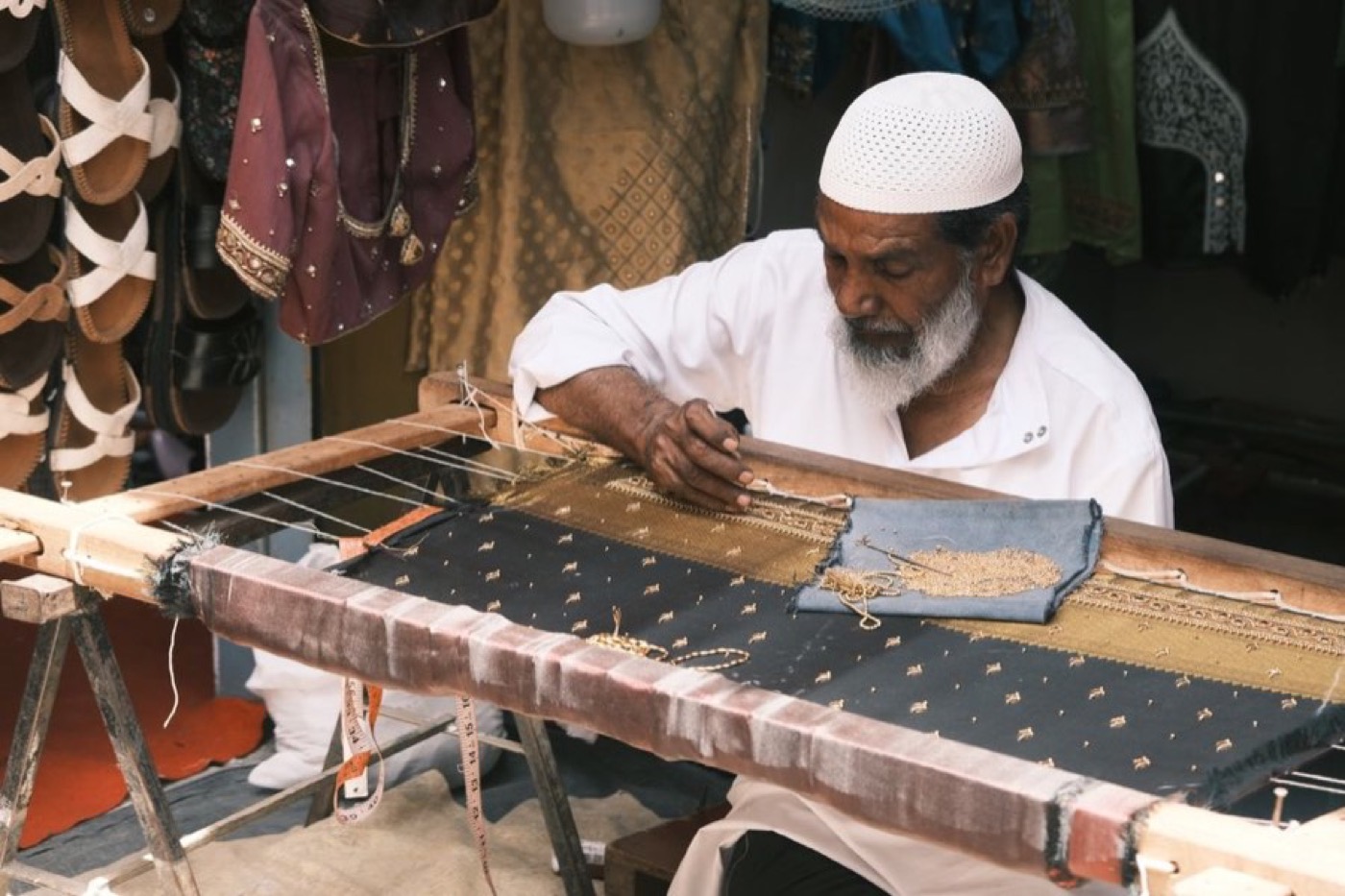
Why the frame matters to you: frame days are the real cost of hand work. When we quote 30–45 working days for heavy bridal, that is a physical frame occupied for that long — which is also why paying in full books it.
The proof is on the reverse
Stitched, never glued
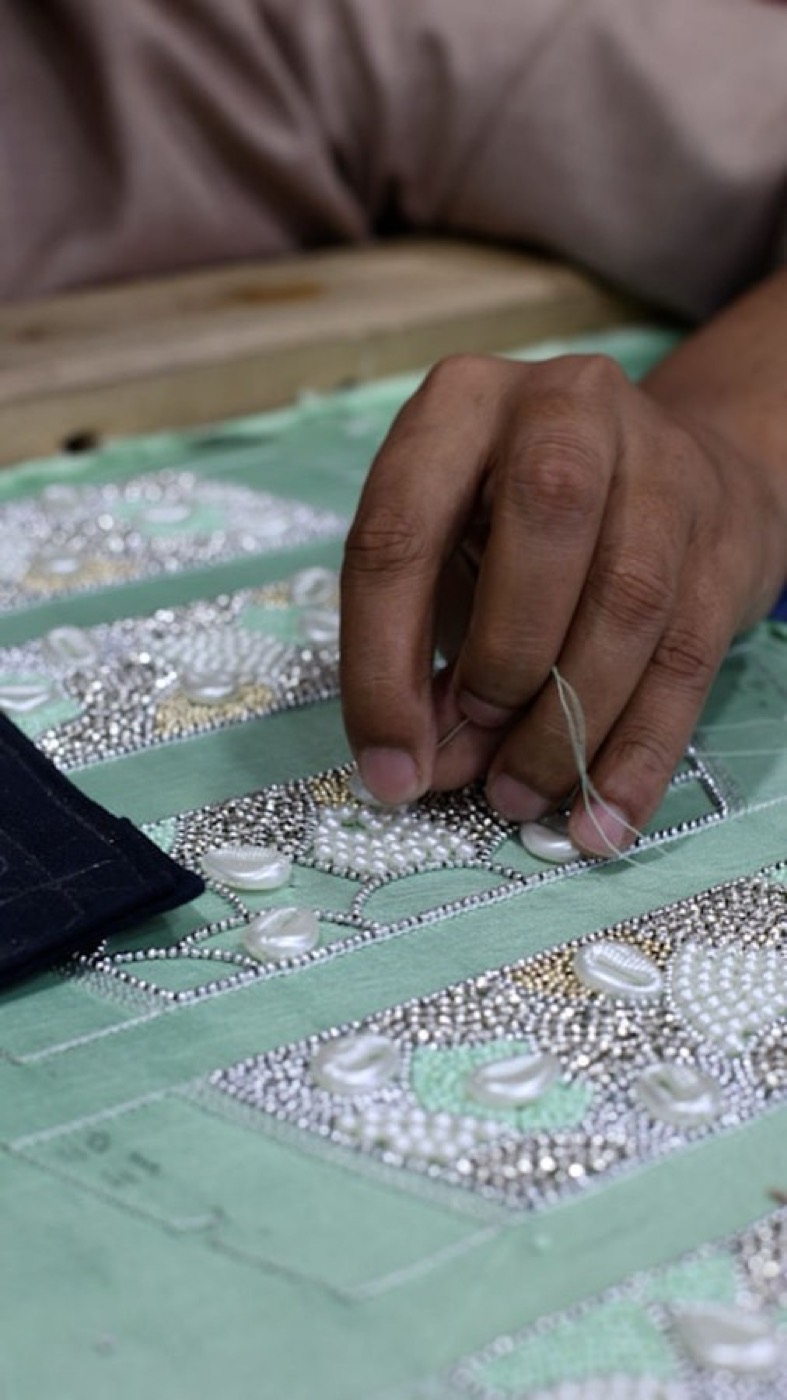
Turn any Sridevi blouse inside out and you will see the work’s honest signature: a clean, continuous chain stitch tracing every motif, because every stone, bead and coil of metal is locked into that stitch by hand. Glued work hides its reverse for a reason — a wash, a warm car boot or one hard function is enough to shed it. Stitched work survives the dry-cleaner, the dance floor and the decade in the cupboard, and when a stone does loosen, it can be stitched back. Glue cannot be undone; a stitch can always be repaired.
The materials glossary
Read a quote like someone who knows the words
These are the materials that appear on our product pages and in your written quote. Knowing them is the difference between comparing prices and comparing work.
Dabka
A fine coiled metal wire, cut into short lengths and stitched down like a bead. The backbone of zardozi outlines.
Nakshi
A faceted, slightly flattened coil that catches light from more angles than plain dabka.
Kundan
Uncut glass or stone set into a claw or foil bed and hand-stitched — the raised focal stones on bridal yokes.
Cutdana
Small faceted glass cylinders. Packed densely they build the lattice fills you see on full-jaal blouses.
Jarkan
Machine-cut crystal stones, graded by size. Used for graded fills and scatter work.
Zari
Metallic thread — gold, antique or silver — couched onto the fabric with a fine silk thread.
Sitara
Tiny flat sequins, usually stitched with a bead in the centre so the thread never shows.
Kora
A matte, un-shiny coil used where the design needs weight without glare.
The price ladder
Coverage is what you are paying for
The tier is simply how much of the blouse is worked, and how many hours that takes on the frame. These bands come straight from the pieces in our catalogue — not from a brochure.
Normal
10–30% coverage
- Hours on the frame
- 10–16 hrs
- Working days
- 7–10
- Price band
- ₹3,200–₹5,900
Thread, zari and stone accents on the neckline and sleeves. Light enough for a temple morning or an office silk.
See normal work blouses →Medium
45–65% coverage
- Hours on the frame
- 48–62 hrs
- Working days
- 15–21
- Price band
- ₹10,500–₹14,000
Worked yokes, sleeves and back panels in dabka, jarkan and pearl. For receptions, sangeet, and the sister of the bride.
See medium work blouses →Heavy
75–90% coverage
- Hours on the frame
- 130–160 hrs
- Working days
- 25–35
- Price band
- ₹24,500–₹33,500
Dense zardozi across yoke, sleeve and back. The weight of a bridal piece without the full jaal — for the family of the bride.
See heavy work blouses →Bridal
80–100% coverage
- Hours on the frame
- 170–210 hrs
- Working days
- 35–45
- Price band
- ₹36,000 onwards
Full-jaal zardozi, kundan and cutdana. 150+ hours on the frame, 90–100% coverage, made for the muhurtham.
See bridal work blouses →Buyer’s eye
How to tell hand work from glued work
Use this on anything — including our own pieces, at the studio, in your hands. A blouse that cannot pass these four checks is not hand embroidery, whatever the tag says.
Stitched holds
Glued sheds
- 1
Turn it over.
Hand work shows an unbroken chain stitch on the reverse — a neat line of loops behind every motif. Glued work shows a flat, often shiny patch of adhesive, or nothing at all.
- 2
Look at a stone's edge.
A stitched stone sits in a visible thread or wire setting; you can see where the thread crosses it. A glued stone sits in a bed of hardened glue, often with a yellowish halo.
- 3
Press a motif gently.
Stitched work flexes with the fabric. Glued work feels like a stiff plate — the adhesive has soaked into the weave and set hard.
- 4
Ask for the hours.
A studio that stitches can tell you how many hours a piece took on the frame, because they paid for those hours. A reseller of glued work usually cannot.
Now look at the work
See what the frame turns out.
Every piece in the shop states its coverage, its materials and its hours — the same vocabulary you just learned. Or keep reading in the journal.